Stiquito
The Stiquito kit is a small, inexpensive hexapod walker powered by
Nitinol (a dynamic alloy) that acts like muscles, pulling the robots legs
back and forth. I received my Stiquito kit with the book Stiquito for
Beginners, but they are also available from the Stiquito website.
Assembly
The assembly of Stiquito was relatively simple in that
there wasn't too many steps. Nevertheless, the robot is just over 7cm
long, making a lot of the steps incredibly fiddly. You have to tie knots
in tiny wires and thread them through tiny holes before
crimping it all together very precisely.
This is not helped by the fact the instructions in the manual were a
little sketchy to say the least, but I managed to make the robot within four hours with help from
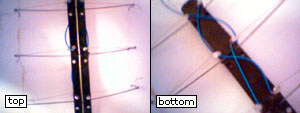
a friend. Below are two shots of the bottom and top of the Stiquito: you
can see how the control wires (blue) are criss-crossed, allowing the
Stiquito to walk using a tripod gait. The top view shows the power bus
that runs down the spine of the robot. The very fine wires you can see
attached to each leg are the nitinol actuators.
The robot can be controlled through various means: the kit
comes with the necessary equipment to manually power the two sets of legs
by using a simple circuit. The neat thing is that the book comes with
additional control ideas and diagrams: via the parallel port of your PC or
an autonomous analog circuit that sits on Stiquito's back.
Operation
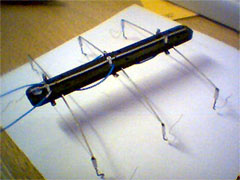
Operation of the Stiquito was...interesting. Using the
manual controller, the legs moved the specified amounts (4-5mm) but it
didn't really go anywhere. This could be due to the surface, but I tried
it on a variety of surfaces and it moved very little on all of them. The
problem seemed to be with the feet that didn't grip much, it worked a
little better when I applied a tiny amount of tack to each foot, but even
then it didn't move all that much. Additionally, the nitinol seemed to
take a while (about a second) to move back into position - therefore,
quick motion was impossible since the nitinol didn't respond quick enough.
Does this mean Stiquito was not worth the effort? Not in the
slightest - there is a definitely "coolness" factor to Stiquito. A tiny
hexapod walker costing a mere $10 using no motors! It is quite creepy
watch the little legs twitch back and forth silently as you control it.
Hopefully, I'll get my hands on a pre-made Stiquito that will no doubt
work much better than my own, as well as the different control circuits,
improving the operation of the Stiquito as well as the appeal.
Conclusion
Stiquito is a neat little robot that will definitely
please whoever finally builds it - it is definitely a challenge in dexterity
and patience. While my robot didn't perform amazingly, it did
work and I feel that some more fine-tuning would have it moving again
nicely. Since I received my kit with the Stiquito for Beginners
book, it is an excellent value-for-money package, since the book is an
excellent introduction to robotics.
-11/04/01
|